Postwar Social Turmoil and Disorder
The Painted BirdPostwar Social Turmoil and Disorder in The Painted Bird is not a clean interval between catastrophe and recovery. The war ends, but its damaged landscapes, displaced populations, broken institutions, and habits of violence remain. The novel follows that unsettled transition through crowded transport and streets, the return of concentration camp survivors, and a city whose apparent daytime peace gives way to danger after dark. In the Afterword, Kosinski also challenges the comforting distance with which some observers regarded war, insisting that survival and the passage of time had not made its consequences disappear.
A Peace Marked by Ruin and Displacement
The boy’s journey by train makes the material condition of the postwar world visible before he reaches the city. The train repeatedly stops at damaged signals, and its route passes bombed-out towns, deserted villages, and abandoned military vehicles. At stations, ragged people ask passengers for food and cigarettes while children watch the passing train. The journey takes two days, but it offers no simple passage from war into safety: the landscape and the people gathered beside the tracks testify to destruction that remains part of ordinary travel.
At a crowded station, military transports, Red Cross carriages, and open cars carrying army equipment compete for the tracks. On the platforms, Soviet soldiers and former prisoners mingle with invalids, civilians, and blind people. Nurses guide emaciated concentration camp survivors in striped clothing through the crowd. The soldiers fall silent as the survivors pass. That pause gives the encounter a force different from the station’s general commotion: people are returning from the camps, but their presence does not mean that the damage has been repaired or that the public has found words for what they endured.
The station also stages a sharp contrast between official ceremony and human aftermath. A foreign military delegation arrives in decorated uniforms as a guard forms and a band plays; nearby, the delegation and the camp survivors pass one another without speaking on the narrow platform. Flags and loudspeaker announcements present a public order being re-established, yet the silent encounter shows how little that display can encompass. The boy and Yury then leave the station for the orphanage, travelling through streets crowded with convoys, soldiers, and pedestrians. The orphanage occupies several old houses, with children looking out from the windows: institutional care has become a destination for children whose family circumstances and wartime histories have been disrupted.
The Strain of Civilian Life
The Afterword broadens the picture beyond the immediate scene of return. Kosinski describes a city receiving large numbers of people from across the country, many hoping that an industrial center will offer work and a chance to recover what they lost. Instead, work and housing are scarce. People crowd the streets and struggle for places on public transport and in restaurants. Their frustration makes them quick-tempered and quarrelsome; many regard survival itself as a claim to special deference. The end of military conflict has not ended competition for the basic conditions of life.
The city’s disorder is not only a matter of shortage. It also appears in the gap between public appearance and what takes place beyond it. The boy observes that daylight gives people a more uniform, predictable aspect, while night reveals a different urban world: drinking, sexual commerce, illicit trading, and violence. In bomb-damaged surroundings, he witnesses a group of boys assaulting a girl; elsewhere, a fight breaks out in a tavern. These episodes are not presented as a return to a stable peacetime routine, but as signs that public order coexists with vulnerability and harm.
The boy becomes familiar with this nighttime city. He sees young people carrying illegal leaflets for distribution on government buildings, while militiamen and soldiers tear the posters down. He also witnesses a manhunt organized by the militia and armed civilians killing a soldier. By day, the city can seem peaceful; after dark, political dissent, policing, and private violence occupy the same streets. The contrast makes the war’s continuation a condition of daily life rather than a single battlefield event.
The Boy Among the Night People
A park near the zoological garden offers the boy a temporary place in this shadow economy. People gather there to trade, drink, and play cards. They treat him kindly, give him scarce chocolate, and teach him to throw a knife and take one from another person’s hand. In return, he carries small packages to different addresses while avoiding militiamen and plain-clothes officers. His inability to speak is useful to the people who employ him because they trust him to keep their business undisclosed. His position is therefore both precarious and socially legible: the same muteness that marks him as an outsider makes him valuable within a community operating beyond official scrutiny.
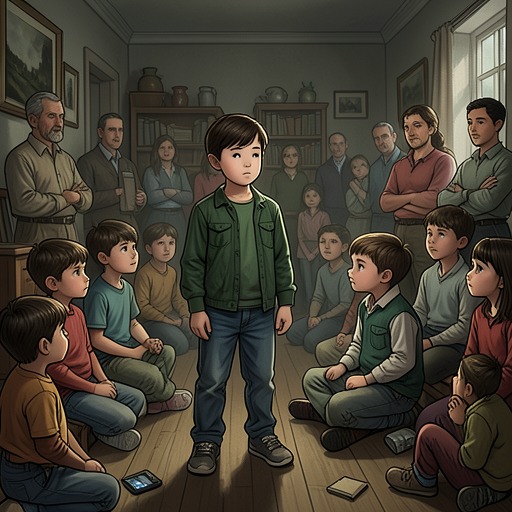
The park’s welcome does not become security. One night, searchlights and police whistles announce a raid; militiamen surround the park and take everyone to jail. When an officer pushes him, the boy nearly breaks the officer’s finger, still relying on the Red Star he wears as a sign of his connection to the military world. The following morning his parents come to collect him. He is dirty and his uniform is torn after a sleepless night, and he regrets leaving the people who had accepted him. His parents offer no explanation for their puzzlement. The episode ends his temporary association with the night community without resolving the conditions that drew him there.
Wartime Violence and Its Afterlife
The novel sets this unsettled aftermath against earlier scenes of persecution and deportation. During the mushroom season, trains carrying Jews and Roma pass through the forest. The peasants hear accounts of their capture and deportation to a concentration camp, yet interpret the persecution through antisemitic religious beliefs, treating German violence as divine punishment. They then direct hostility at the dark-haired boy, calling him a Jew and a Gypsy and threatening to burn him. The scene connects state persecution to local prejudice: the boy is endangered not only by the machinery of deportation but also by a community that accepts its logic and turns it against him.
The trains also expose the distance between the people inside them and the villagers watching from the tracks. Villagers wave to the trains, and passengers visible through the small windows may mistake those gestures for a greeting. Their answering signals become visible only briefly before the cars pass. On another occasion, villagers search the railway embankment after several trains have gone by and find a small boy who has fallen from one. The onlookers take his clothes and leave his body on the track for the German patrol to find. Later, the narrator picks up human ash from beside the railway. The material remains and the boy’s sense that the dead may continue to haunt the living make the violence persist in the landscape and in memory, not merely in recollection of a past event.
Kosinski’s Afterword distinguishes the novel’s fictional form from the historical record while arguing that its brutality should not be dismissed as exaggeration. He points to survivor testimony about German reprisals against a village that sheltered an enemy of the Reich, and to camp documents describing the killing of children deemed too young to work, the collection of clothing taken from murdered Jewish children, and the deaths of Roma children. These materials are presented as evidence that wartime violence in Eastern Europe exceeded the limits some critics were willing to acknowledge. They do not turn the novel into documentary testimony; rather, they place its imagined scenes within a historical context of mass persecution and destruction.
Memory, Reception, and the Meaning of Survival
The Afterword also locates postwar disorder in a conflict over how the war could be understood. In 1963, while visiting Switzerland with his seriously ill wife, Kosinski encountered wealthy European exiles who had fled before the slaughter began and now lived within the relative safety of a resort hotel. He found their confidence in the good intentions of political leaders and their view of war as an inexplicable aberration irreconcilable with the destruction he knew. That discrepancy helped lead him away from social science and toward fiction, which he believed could represent lives as they were actually lived rather than promises of a utopian future.
The reception of The Painted Bird repeats that struggle over memory. Kosinski says he resisted presenting himself as a spokesman for everyone who had survived: survival, in his view, entitled a survivor to speak for himself, not for an entire generation. He wanted the novel to stand independently of his biography. After its publication in the United States and Western Europe, East European publications attacked it as politically motivated or as a libelous account of identifiable local communities; other critics objected to its brutality or treated it as merely personal reminiscence. For Kosinski, these responses evaded the distance between an orderly account of peace and the experiences of people who had endured the war without the possibility of escape.
By the late 1960s, students and teachers were reading the novel in modern literature courses. Some readers, especially members of ethnic minorities and people who felt socially disadvantaged, recognized in the boy’s ordeal a pattern of exclusion that continued in ghettos and cities: language, color, and education could mark people as outsiders vulnerable to the powerful majority. This reception extends the book’s account of disorder beyond the immediate postwar setting. The war’s end changes the circumstances in which the boy lives, but it does not guarantee belonging, safety, or a shared understanding of what has happened. The city’s crowded streets and divided nighttime world thus form part of a larger aftermath in which survival is real, while recovery and social peace remain incomplete.